
|
|
Music: Mitch Leigh
Lyrics: Joe Darion
Book: Dale Wasserman
Presented by the University of Indiananpolis Department of Theatre through special arrangement with the Tams-Witmark Musical Library
October 13-15, 20-22 2000
Ransburg Auditorium, Esch Hall
University of Indianapolis
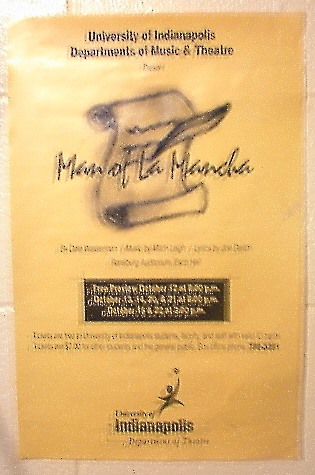
Promotional Poster from this production. I have it laminated and hanging
in my dorm room.
(My apologies for the blurry photo...lamination does that.)
Directed by Jim Ream
Assistant Director Kelsie Brummett
Music and Vocal Direction by Pete Schmutte
Choreography by Andre Megerdichian
CAST
|
CHARACTERS Captain of the Inquisition - Chad Bussell
|
ENSEMBLE (MULETEERS) Pedro - Steve Fisher
|
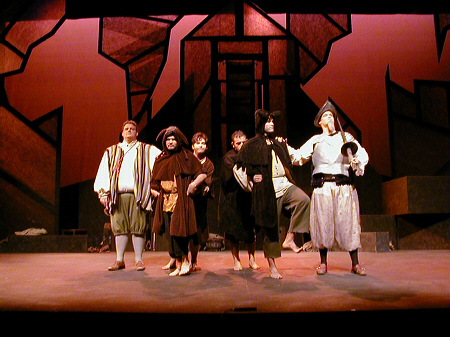
Ben Barhan portrays Sancho's burro while Steve Fisher portrays Don Quixote's horse. |
|
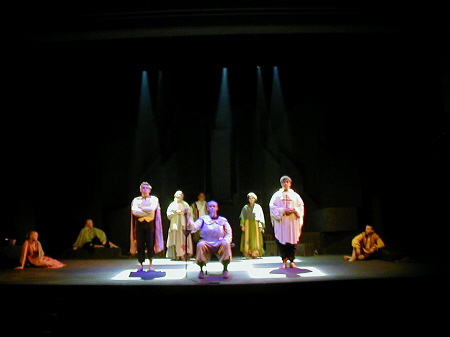
The chess game of "I'm Only
|
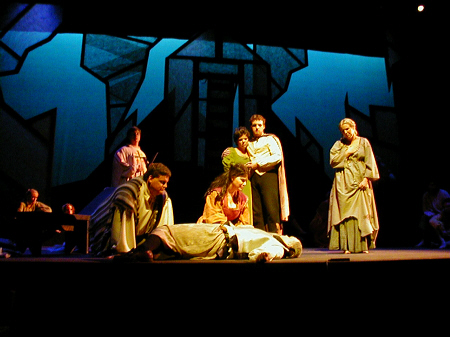
Don Quixote's death |
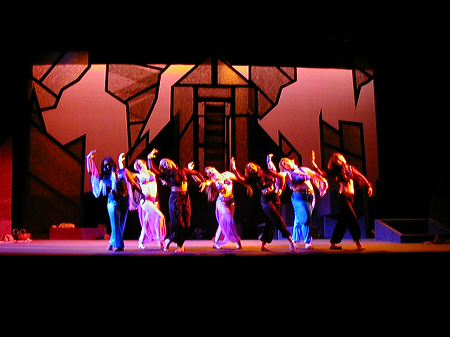
The Moorish Dance
|
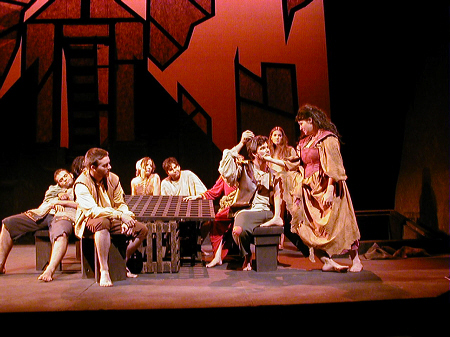
Aldonza sings to the muleteers |
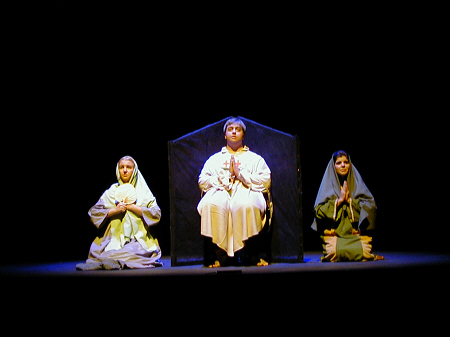
Cara Silletto as the Housekeeper,
|
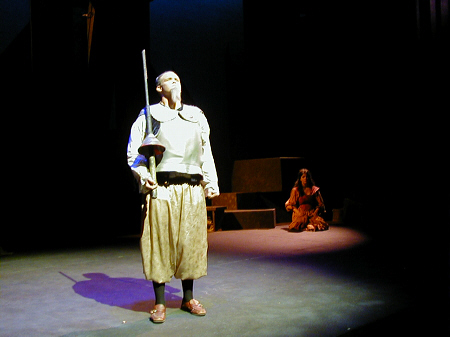
Mitchell Hammersley as
|
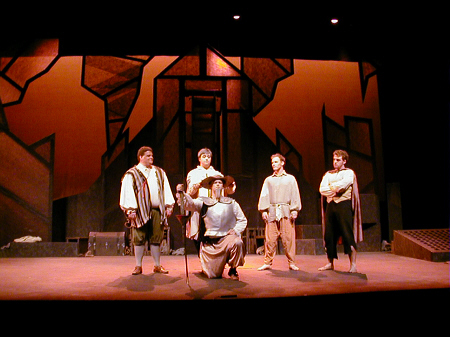
The Golden Helmet of Mambrino is laid on Don Quixote's head. |
Plot Summary and History - Courtesy of Moonstruck Drama Bookstore
Based on I, Don Quixote, a television play by librettist Dale Wasserman, Man of La Mancha begins with the imprisonment of novelist Miguel de Cervantes y Saavedra during the Spanish Inquisition. Thrown into a dark prison to await trial, Cervantes and his faithful servant soon find themselves set upon by the other inmates, a bloodthirsty horde of theives and murderers who organize an underworld trial in which the new inmates must defend themselves before "The Governor," the self-annointed kingpin of the prison.
Being a novelist, Cervantes convinces The Governor that his defense should take the form of an entertainment. He will present the story of a country squire named Alonso Quijana who, overwhelmed by the evil that men do toward men, put aside his sanity and set out into the world as a knight errant, dubbing himself Don Quixote of La Mancha, champion of the oppressed and righter of wrongs. The Governor agrees, and Cervantes begins to spin his tale, telling how Quijana left behind his family, and set out along a great highway to glory, a road which looked, to his servant Sancho, remarkably like the road to El Toboso where the chickens are cheap. After a misguided attempt to do battle with a windmill, the two men eventually stumble upon a great castle--or a small inn, depending upon which of them you ask. The inn is populated by a band of rough drinkers and several women of easy virtue, one of whom Don Quixote hails as "a sweet lady and a fair virgin" and proceeds to worship as his "Dulcinea." Aldonza, the whore Don Quixote has chosen, doesn't know quite what to make of this, and when Don Quixote sends Sancho asking for a token to carry into battle, she assumes that he wants what every man wants and angrily tosses him a dish rag. Aldonza is intrigued, however, by Don Quixote's strange words and his gentle manner, and when the old man successfully defends her against a whole band of manhandling hooligans, she is finally won over to his quest which he describes to her in song as "The Impossible Dream."
Meanwhile, however, Quijana's family has convinced the self-important Dr. Carrasco to retrieve their mad patriarch. Carrasco is not so much interested the Quijana's well being as he is in the old man's fortune, which Carrasco stands to inherit as he is engaged to Quijana's neice. When the doctor arrives at the inn, Quijana mistakes him for the Great Enchanter, the most dangerous enemy of all good men. Don Quixote prepares to do battle once more, but this time, he has no defense against his enemy's weapon--a bright, mirrored shield in which the old man can see nothing but his old, foolish reflection. Thus defeated, Quijana returns home and agrees to draw up his will in his neice's favor--that is, until he receives an unexpected guest from the inn who begs him not to renounce "The Impossible Dream."
The Governor is impressed with Cervantes defense, as are the other prisoners, and the novelist's crimes are forgiven. But now the guards have returned, and Cervantes has managed to defend himself in front of one court only to be dragged in front of another. It has not been wasted time, however, for as he climbs the steps out of his dark prison,he can hear the prisoners below still singing "The Impossible Dream."
Man of La Mancha opened Off-Broadway at the Anta Washington Square Theatre on November 22, 1965 with a cast that featured Richard Kiley (Don Quixote), Joan Diener (Aldonza), and Irving Jacobson (Sancho). The production was a resounding critical success, and in March of 1968, it was transferred to the Martin Beck Theatre on Broadway, where it continued a run which would eventually reach 2,328 performances and go down in the record books as the third longest running musical of the 1960's. The 1972 film version featured Peter O'Toole, Sophia Loren, and James Coco.